Forehead Wrinkles, Frown Lines & 11 Lines: Face Yoga vs Botox
Updated: Jan 28
Forehead wrinkles, frown lines, and 11 lines are often the first facial changes people notice.
They are highly visible. They are closely linked to stress and facial expressions. And for many women, they become the moment when a question quietly appears: Should I do something about this?

This is also why the forehead is the number one entry point into face yoga. Most people start searching for solutions here — often before considering injectables like Botox.
But to understand how to care for this area effectively, we first need to shift the way we look at forehead lines.
Forehead Wrinkles Are Not Just a Skin Issue
Forehead lines rarely come from aging alone.
In most cases, they develop from a combination of:
Repetitive facial expressions
Chronic muscle tension
Stress and nervous system overload
Habitual holding patterns in the face
The forehead is deeply connected to how we respond to stress, focus, and emotion. Many of us raise, tighten, or furrow the brow unconsciously throughout the day. Over time, these repeated contractions leave marks that remain even when the face is at rest.

Crucially, the frontalis muscle on the forehead is connected via the scalp fascia to the occipitalis muscle at the back of the head. This means tension in the occipitals can pull on the forehead, affecting lines and tightness. Targeting only the forehead with exercises is often not enough — the back of the head and scalp must also be addressed for full relaxation and lasting results.
This is why topical skincare alone often falls short. Creams work on the surface, while forehead lines are formed deeper — in the muscles, fascia, and movement patterns of the face.
Botox vs Face Yoga: Two Very Different Approaches
When comparing face yoga and Botox, it’s important to understand that they are based on completely different philosophies.
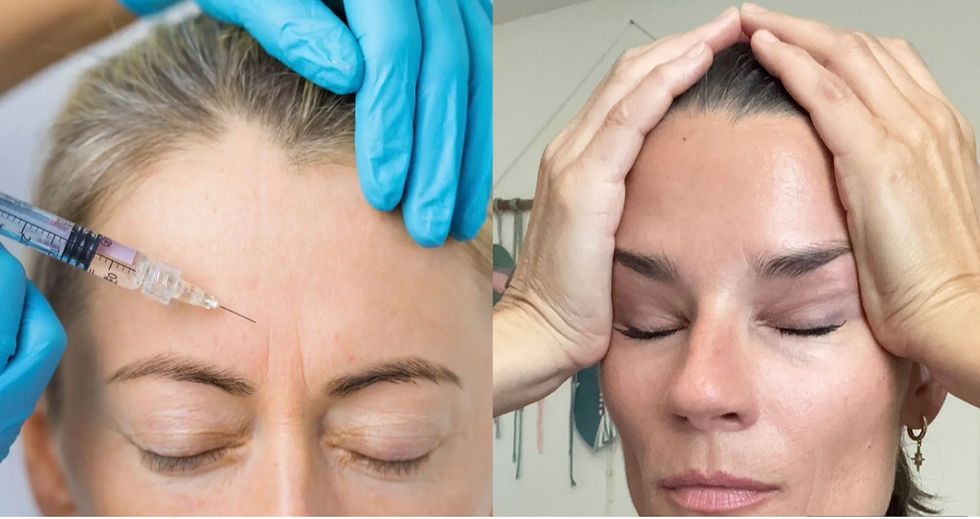
Botox
Botox works by temporarily blocking nerve signals to specific muscles, reducing their ability to contract. This limits movement in the forehead, which can soften the appearance of lines in the short term.
However, Botox does not address:
Why tension is present
How facial habits were formed
Circulation and tissue health
Emotional and nervous system patterns
It pauses movement, but it does not retrain the face.
Face Yoga
Face yoga works by restoring balance rather than stopping movement.
A holistic face yoga approach focuses on:
Strengthening underused muscles
Releasing chronically overactive muscles
Improving blood flow and oxygenation
Increasing awareness of facial habits
Releasing tension from connected areas like the occipitals
Instead of freezing expression, face yoga teaches the face how to move with less tension and more efficiency. This integrated approach allows relaxation to flow from the scalp to the forehead, supporting both appearance and overall comfort.
Why the Forehead Needs More Than Exercises
Forehead care should never rely on exercises alone.
Because this area is often dominated by tension, it benefits just as much — if not more — from practices that release and soften the tissues. Addressing the scalp and back of the head ensures the frontal muscle can truly relax.
Facial Massage
Massage helps soften tight muscles, improve tissue quality, and reduce habitual holding in the brow and scalp. It prepares the forehead for movement by creating space and ease.
Facial Cupping
Cupping supports lymphatic drainage and circulation. In the forehead, it can help reduce stagnation, puffiness, and dullness while bringing fresh blood flow to the area.
Gua Sha
Gua Sha works on the fascia — the connective tissue that influences how the skin moves and rests. Gentle Gua Sha techniques for the forehead and scalp can help release restrictions, encourage fluid movement, and support natural contour.
When these practices are combined with face yoga, the forehead becomes more responsive, relaxed, and balanced.
What Changes With Consistent Practice
With regular, gentle care, many people begin to notice subtle but meaningful shifts in their forehead:

A feeling of lightness and ease
Less unconscious tension throughout the day
Improved warmth and circulation
Softer resting expression
Lines appearing less deep or less fixed
These changes don’t happen because the face is forced into stillness. They happen because the tissues become healthier — from scalp to brow.
A Sustainable Alternative to Quick Fixes
Face yoga and holistic facial care do not promise instant results.
What they offer instead is a sustainable, respectful way to support facial health over time — one that honors expression, movement, and emotional wellbeing.
For many women, this approach becomes more than a technique. It becomes a daily ritual of awareness, release, and self-care.
Forehead lines don’t need to be battled. They need to be understood.
Bringing It All Together
Forehead wrinkles, frown lines, and 11 lines are not a sign that something is wrong with your face. They are often a reflection of how you move, feel, and respond to life.
When you support the forehead with a holistic approach — combining face yoga, massage, cupping, and Gua Sha — you’re not trying to erase age. You’re supporting circulation, releasing tension, and restoring balance, including the critical connection from the occipitals to the frontal.
Youthfulness, when it appears, becomes a side effect of care.
If you’re looking for guided support and a structured yet flexible way to care for your forehead and your face as a whole, this is the philosophy behind the I Am Glowing method.
Your face doesn’t need to be frozen. It needs attention, movement, and understanding.
Ready to care for your forehead in a way that respects your face?
Inside the I Am Glowing membership, you’ll find a library full of guided face yoga, facial massage, cupping, and Gua Sha practices designed to release tension from the forehead, scalp, and entire face — gently and sustainably.
This is not about doing more. It’s about doing what actually supports long-term facial health.

Comments